
Lower your internet bill
61% of people overpay for their internet.
Are you one of them?
Unlock exclusive offers in your area!
Call now
[tel]Enter zip code




















 Use code: KALA & receive a $50 gift card with your order!
 Are you happy with your Internet service?

About the author
Trying to decide between Spectrum or Xfinity? These are the two largest hybrid fiber coaxial (HFC) internet providers in the United States, together covering well over 200 million people [1]. On the surface, they look nearly identical: both use hybrid fiber-coaxial (HFC) networks and compete in the same general price range. But once you dig into the details of Spectrum vs Xfinity pricing, data caps, and the fine print, the differences become significant. This internet comparison will break down everything you need to know so you can find the best internet in your area.
Lower your internet bill
61% of people overpay for their internet.
Are you one of them?
Unlock exclusive offers in your area!
Call now
[tel]Enter zip code
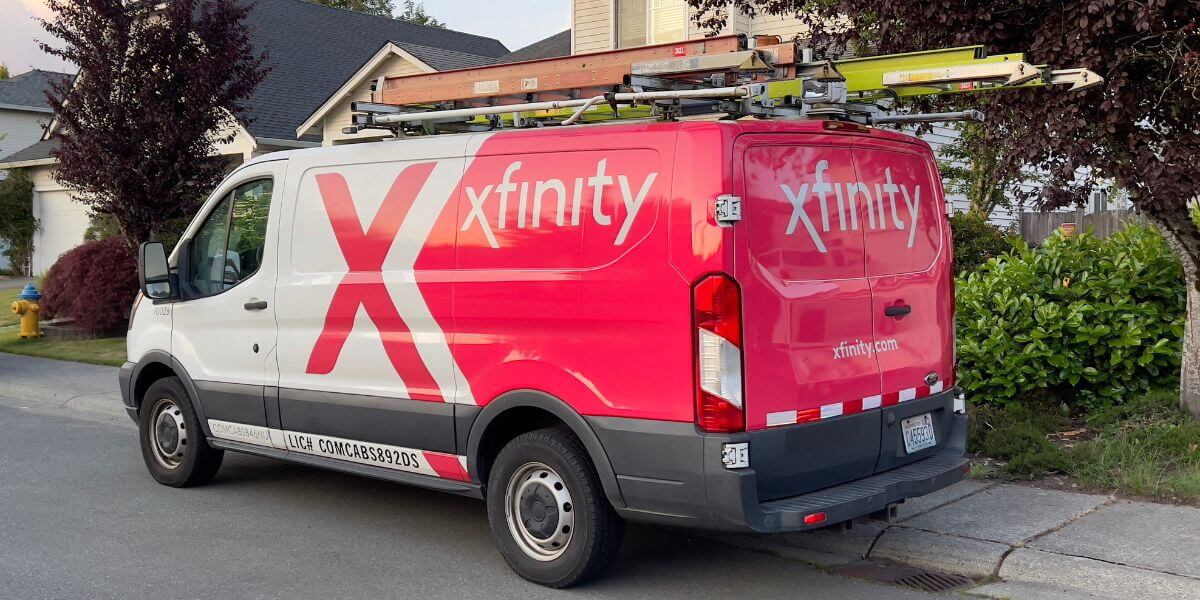
What Is Hybrid Fiber-Coaxial Internet, and Why Does It Matter?
Both Spectrum and Xfinity use HFC (hybrid fiber-coaxial) technology, which are fiber optic lines running to neighborhood nodes, with coaxial cable for the last stretch to your home. Both providers are actively rolling out DOCSIS 4.0, the latest cable standard that promises multi-gigabit speeds and lower latency [2].
The implication is that performance from either provider depends heavily on how recently the cable infrastructure in your specific neighborhood has been upgraded. Two customers on the same plan in different zip codes can have noticeably different experiences.
Spectrum’s 2026 promotional pricing looks roughly like this in many markets, though tier names and rates vary significantly by location [3]:
| Plan | Speed | Promo Price |
| Internet Advantage | 100 Mbps | ~$30/mo. |
| Internet Premier | 500 Mbps | ~$40/mo. |
| Internet Gig | 1,000 Mbps | ~$50/mo. |
| Internet 2 Gig | 2,000 Mbps | ~$90/mo. |
These are introductory rates from one provider snapshot; other sources report a three-tier lineup (300 / 500 / 1,000 Mbps) and standard post-promo rates closer to $80–$120/month. Confirm the exact plans and prices available at your address before deciding.
All Spectrum plans include a free modem. Note, though, that Spectrum charges separately for its Wi-Fi router (its “Advanced Wi-Fi" service) — typically around $7–10/month — on its lower tiers, with the router bundled in only on the Gig and 2 Gig plans. You can sidestep that fee by pairing the free modem with your own router. Xfinity’s 2026 plans start lower but come with more variables [4]:
| Plan | Speed | Promo Price |
| Connect | 75 Mbps | ~$20–30/mo. |
| Fast | 400 Mbps | ~$60/mo. |
| Superfast | 800 Mbps | ~$70/mo. |
| Gigabit | 1,200 Mbps | ~$80/mo. |
| Gigabit x2 | 2,000 Mbps | ~$120/mo. |
Xfinity’s lower entry price is appealing, but historically the headline rate excluded a gateway rental fee of around $15/month. As of 2026 this is in flux — several of Xfinity’s newer national plans now bundle equipment (and unlimited data) into the advertised price — so check whether equipment is included on the specific plan you’re quoted. Both providers use promotional pricing that expires after 12 months, after which rates commonly jump $20–30/month. When you compare internet plans beyond the promo window, Spectrum’s pricing tends to be more predictable.

Spectrum vs Xfinity Data Caps: The Biggest Differentiator
This is where the Spectrum vs Xfinity comparison gets decisive for many households.
Spectrum has no data caps on any of its residential plans. You can stream 4K video, work from home on video calls, and game online without ever worrying about hitting a monthly ceiling.
Xfinity has historically enforced a 1.2 TB (terabyte) monthly data cap in most markets. To put that in perspective, streaming a 4K movie uses roughly 7 GB per hour. A household doing regular 4K streaming, gaming, and video conferencing can approach or exceed 1.2 TB in a month. Customers who go over are charged $10 per additional 50 GB block, up to a maximum of $100/month in overages.
There is a caveat, though. As of 2026, Xfinity has removed the cap for customers on its 5-Year Price Guarantee plan or xFi Complete bundle. However, legacy plans and some markets still carry the cap, so confirm your specific plan’s terms before signing up. For heavy internet users, the Spectrum vs Xfinity data caps question is often a dealbreaker in Spectrum’s favor.
Both providers offer impressive speed ceilings on paper, but real-world performance depends on your local network. Independent testing by Ookla shows both perform comparably for hybrid fiber coaxial (HFC) internet, with Xfinity holding a slight edge at the top end thanks to its higher-speed tiers [5].
On upload speeds, both providers have historically been modest on lower tiers — Xfinity around 5–20 Mbps and Spectrum around 10–40 Mbps below the gigabit level. Both are rolling out major upload upgrades in 2026, though: Xfinity now reaches up to roughly 200 Mbps uploads in markets upgraded to mid-split technology, and Spectrum has announced increases toward 150–500 Mbps. Whether you see these depends on whether your specific area has been upgraded.

Xfinity vs Spectrum Customer Service: Neither Wins Easily
When it comes to Xfinity vs Spectrum customer service, both providers have room for improvement. Cable internet providers as a category consistently score below fiber providers like Verizon Fios and Google Fiber in major satisfaction studies.
In the J.D. Power 2025 U.S. Television Service Provider Satisfaction Study—which measures overlapping satisfaction factors—Spectrum scored 536 and Xfinity scored 533 out of 1,000, with both trailing Verizon Fios (577) [6].
Both providers offer 24/7 phone support, online chat, and in-store locations. Xfinity has invested in its xFi app for self-service tasks like restarting equipment and checking outages. Spectrum has similarly improved its app and in-store experience. Your satisfaction will likely depend more on local technicians and infrastructure quality than on the brand itself.
So, which is better, Spectrum or Xfinity? The answer depends on your priorities.
Choose Spectrum if:
Choose Xfinity if:
One final note: these two providers rarely overlap. Xfinity reaches roughly 126 million people — about 36% of the U.S. — while Spectrum covers a largely separate footprint of about 113 million. In most markets, you’ll only have access to one of them, and availability makes the decision for you. Enter your zip code below to see which providers are actually available at your address.
Enter your zip code below to find internet service providers that may be available in your neighborhood, including Xfinity and Spectrum.
Lower your internet bill
61% of people overpay for their internet.
Are you one of them?
Unlock exclusive offers in your area!
Call now
[tel]Enter zip code
Xfinity has a slightly higher speed ceiling on its top-tier plans (up to 2 Gbps), but both providers perform comparably on mid-tier cable plans in independent testing. Real-world speeds depend on your local infrastructure, not just the advertised maximums.
No. Spectrum does not impose any data caps on its residential internet plans. You can use as much data as you need each month without overage charges.
Most standard Xfinity plans in most markets still carry a 1.2 TB monthly data cap, though Xfinity has eliminated it for customers on its 5-Year Price Guarantee or xFi Complete plan. Always confirm your specific plan’s terms, as policies vary by market.
Almost certainly not. These two providers have largely non-overlapping service territories, meaning most households will only have access to one. Use our zip code tool to find out which internet providers serve your specific address.
[1] ISPReports.org. “XFINITY vs. Spectrum – Internet Provider Comparisons."
[2] Xfitity. “Internet Service.”
[3] Spectrum. “Spectrum Internet Plans.”
[4] ConnectCalifornia. “Xfinity Internet Pricing 2026 (Includes Upload Speeds)."
[5] Ookla. “Fastest ISP XFINITY.”
[6] J.D. Power. “2025 U.S. Television Service Provider Satisfaction Study."
Do you want to leave a review for AT&T Internet?
About the author

Infinity Sales Group, LLC