
Lower your internet bill
61% of people overpay for their internet.
Are you one of them?
Unlock exclusive offers in your area!
Call now
[tel]Enter zip code




















 Use code: KALA & receive a $50 gift card with your order!
 Are you happy with your Internet service?

About the author
The home internet market has changed significantly over the last decade. Hybrid Fiber Coaxial (HFC) providers like Spectrum long dominated residential broadband through coaxial infrastructure originally built for cable TV.
Then came 5G fixed wireless access (FWA), and T-Mobile’s Home Internet service, launched broadly in 2021 [1], changed the conversation by delivering broadband-class speeds over its nationwide cellular network without a single cable or technician visit.
But which one is best for your needs?
If raw speed and low intro pricing are your top priorities, Spectrum is the stronger pick. If you value pricing transparency, hassle-free setup, and long-term budget predictability, T-Mobile Home Internet is hard to beat. Read on for the full breakdown.
Lower your internet bill
61% of people overpay for their internet.
Are you one of them?
Unlock exclusive offers in your area!
Call now
[tel]Enter zip code
Today, the Spectrum vs. T-Mobile internet comparison and every other option out there is a common decision households face when choosing a provider. According to the FCC’s 2024 Broadband Data Collection [2], fixed wireless access is now one of the fastest-growing segments in U.S. home internet, adding millions of subscribers annually.
Here’s a high-level comparison before we dive deeper:
| Category | Spectrum [3] | T-Mobile Home Internet [4] |
| Starting price | $30/mo. (intro, 1 yr) | $50/mo. (w/ AutoPay) |
| Speed range | Up to 100–2,000 Mbps | Up to 318–498 Mbps |
| Internet type | Cable / limited fiber | 5G fixed wireless |
| Data cap | None | None |
| Contract | None | None |
| Price hike after year 1? | Yes | No (5-year lock) |
| Equipment fee | $10–$30/mo. for WiFi | Free gateway included |
How Much Do Spectrum and T-Mobile Cost?
The advertised monthly price is only part of the equation, as extra fees and post-promotional rate hikes can dramatically affect your actual budget for both providers.
Spectrum’s intro rates are genuinely competitive. Plans range from $30/month for the Advantage tier (up to 100 Mbps) to $90/month for the 2 Gig tier, with Premier ($50/month, 500 Mbps) and standard Gig ($70/month, 1,000 Mbps) covering most households’ needs in between.
The catch is the Spectrum price hike. These are promotional rates for new customers, good for the first 12 months only. After that, expect your bill to climb by $20 or more per month depending on your plan and region.
T-Mobile offers three home internet tiers: Rely ($50/month, up to 318 Mbps), Amplified ($60/month, up to 498 Mbps), and All-In ($70/month, up to 498 Mbps, with Hulu and Paramount+ included). All plans require AutoPay for the discounted rate and are subject to taxes and fees.
What distinguishes T-Mobile on pricing isn’t just the rates, it’s the T-Mobile price guarantee, which locks your monthly rate for five years. For budget-conscious households doing a true internet comparison over time, that predictability can outweigh Spectrum’s cheaper starting price.

What Extra Fees Should You Expect?
Fees are where the gap between these two providers becomes more apparent. In any honest internet prices analysis, the advertised rate is only part of the picture. Spectrum’s fees to watch:
Spectrum doesn’t charge a modem rental fee, which is a plus, but if you use their gateway (which most customers do), you’re paying a monthly WiFi fee on most plans. That $10/month charge adds $120/year to your actual cost. T-Mobile’s fee structure is simpler:
T-Mobile’s model is more transparent. You get a free gateway, pay $35 once to activate, and your monthly rate stays stable. There are no router rental charges, no installation fees, and no technician to schedule.
Based on CompareInternet’s rankings, T-Mobile Home Internet outscored Spectrum across almost single category:
| Category | Spectrum | T-Mobile |
| Overall rating | 4.2 / 5 | 4.4 / 5 |
| Price satisfaction | 4.2 / 5 | 4.5 / 5 |
| Reliability & performance | 4.5 / 5 | 4.3 / 5 |
| Equipment, Installation & Bonus Features | 4.3 / 5 | 4.5 / 5 |
| Customer service | 3.8 / 5 | 4.3 / 5 |
The widest gap is in customer service, with Spectrum lagging behind. T-Mobile’s lead in customer service is notable, reflecting its reputation for straightforward, no-hassle policies. However, Spectrum does rank higher in reliability and performance.
This may be one of the most important (and most misunderstood) aspects of the T-Mobile 5G home internet vs. cable debate.
Spectrum primarily delivers internet via cable infrastructure using coaxial lines, the same physical wiring that once carried cable TV signals. Cable is a mature, proven technology offering consistent performance and high ceiling speeds. Spectrum is also expanding its fiber footprint in select markets, where available speeds reach up to 2 Gbps.
T-Mobile Home Internet uses 5G fixed wireless access, which is the same cellular network technology that powers your smartphone, redirected to your home router. There are no cables, no buried lines, and no physical infrastructure tied to your address. T-Mobile’s gateway receives a 5G signal from nearby cell towers and broadcasts WiFi throughout your home.
The practical difference is that hybrid fiber coaxial (HFC) internet (Spectrum) tends to offer more consistent speeds, especially for households with heavy simultaneous usage—remote workers, gamers, and homes with many connected devices. Fixed wireless performance can vary based on tower congestion during peak hours. T-Mobile’s speeds are good enough for most households, but it’s worth considering if you’re a bandwidth-heavy user.

How Does Installation Work?
If convenience matters to you, T-Mobile wins this category without much debate.
Setting up T-Mobile Home Internet takes roughly 15 minutes. The T-Mobile app guides you to the optimal placement for the gateway in your home, you plug it into power, connect through the app, and you’re online. No technician, no appointment, no waiting window.
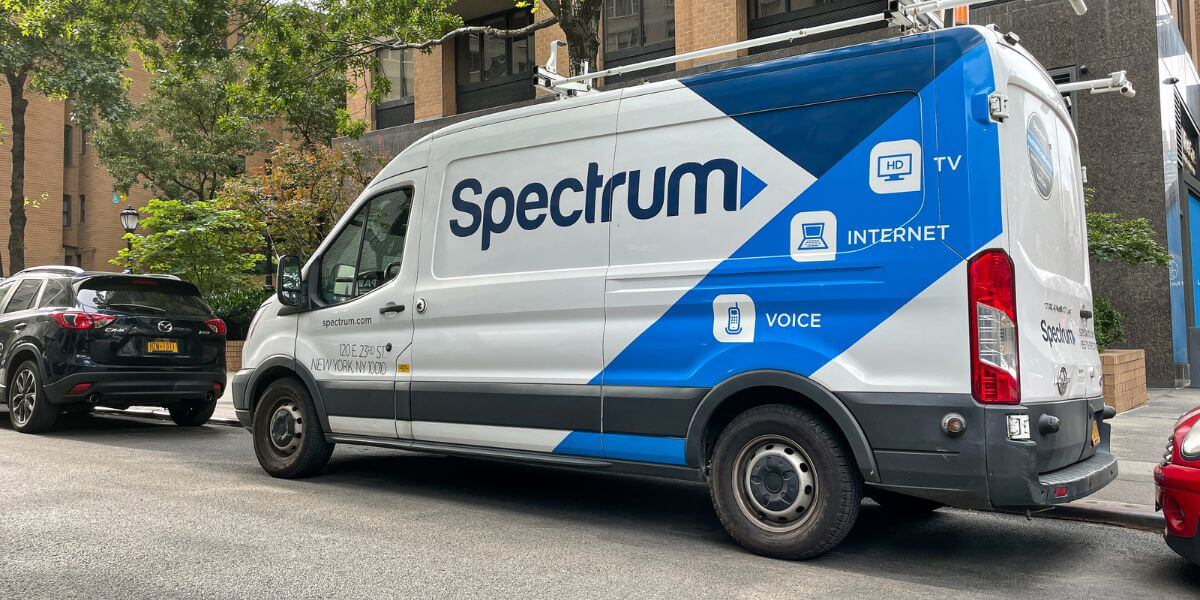
Spectrum’s installation involves more variables. Professional installation costs $65 and requires scheduling a broadband technician [5]. The self-install option is cheaper ($30) but comes with a significant caveat: it only works if your home already has an active connection to the Spectrum network. If it doesn’t, self-install won’t work and you’ll need a pro visit anyway.
After a thorough internet comparison, the answer depends on what you’re optimizing for: Choose Spectrum if you:
Choose T-Mobile Home Internet if you:
Both providers offer no contracts and no data caps, which means you’re never locked in and never throttled for heavy usage. The decision really comes down to whether speed and intro-rate savings (Spectrum) outweigh long-term pricing stability and ease of use (T-Mobile).
Enter your zip code to find the best internet in your area and compare internet plans available at your address.
Lower your internet bill
61% of people overpay for their internet.
Are you one of them?
Unlock exclusive offers in your area!
Call now
[tel]Enter zip code
No—Spectrum offers faster maximum speeds. Spectrum’s plans reach up to 2,000 Mbps, while T-Mobile’s top tier caps at 498 Mbps. That said, T-Mobile’s speeds are sufficient for the vast majority of households. Unless you have unusually high bandwidth demands, you’re unlikely to notice a real-world difference.
Yes. Spectrum’s advertised prices are promotional intro rates available to new customers for the first 12 months. After that, your monthly bill typically increases by $20 or more depending on your plan and market. This is one of the main reasons customers favor T-Mobile’s 5-year price guarantee in long-term internet provider comparisons.
With Spectrum, you can use your own compatible modem (Spectrum doesn’t charge a modem fee), but if you use their gateway or Advanced WiFi router, additional monthly fees apply. T-Mobile provides its own gateway as part of the service at no extra charge, and the service is designed to work specifically with that hardware — using a third-party router is not officially supported.
T-Mobile’s 5G Home Internet is broadly available across most populated areas in the U.S., leveraging its existing nationwide cellular network. Spectrum’s cable network covers a significant portion of the country but is concentrated in urban and suburban markets, particularly in the Northeast, Southeast, and parts of the Midwest. Availability varies significantly by address, so the most reliable way to compare internet providers at your location is to check by zip code.
[2] FCC. “2024 Broadband Data Collection.”
[3] Spectrum. “Internet Plans.”
Do you want to leave a review for AT&T Internet?
About the author

Infinity Sales Group, LLC